Kim Hyeongsun – Haenyeo’s Face
By Park Young-taik, Gyeonggi University Professor & Art Critic
Also referred to as jamnyeo or jamsu, haenyo, haenyeo (female divers on Jeju Island) gather conch, abalone, and seaweed in shallow water 10 meters below the ocean’s surface without using any specific equipment. They have engaged in this work for generations. Jeju women are known for learning how to swim around seven and eight years old and become haenyeo around fifteen and sixteen. They are most active in their forties and continue to work into their sixties. However, things seem to be changing. The number of haenyeo currently registered in the Jeju provincial government is 4,900 but only approximately 2,500 haenyeo, most of whom are over sixty years old, are substantially working. These female divers will continue to work until no longer physically possible. The tools necessary for their work include floats, harpoons, hooks, wet towels, swimming goggles and diving suits. They pick up what they find underwater using this basic equipment, all the while holding their breath.
For humans who have to breathe air, underwater can be a space of death as human lungs are useless there. The human body is put in a space completely different from that above ground due to water pressure, heavy matter, and the lack of oxygen. The sea’s water surface is a border between life and death. Haenyeo frequently cross over this boundary. After breathing in as much air as possible above the surface, they remain underwater for as long as they can stand. The instant they break the water’s surface is the moment when they feel that they are at the crossroads between life and death. They continue to repeat this process of going to death’s door and returning to Earth. What must their lives be like?
Kim Hyeongsun photographed Jeju’s haenyeo for three years from 2012 to 2014. He took photographs of haenyeo involved in diving work in Onpyeong, Seongsan, Hamo, Haye, Hadong, Moseulpo, Hwasun, Gosan, Geumdong, Daepyeong, Hallim, and Gueop of the mainland Jeju island and its satellite islands such as Biyangdo, Gapado, Marado, and Udo. He vividly captured the moment when hanyeo just came out of the water after finishing their diving work without using any oxygen-supply equipment. These haenyeo staring into the camera lense appear exhausted. Their expressions are filled with some feeling of reality. Although they have a lot of experience, it is still arduous, laborious work. It is thus common knowledge that most haehyeo rely on sedatives and painkillers. We cannot imagine the immense difficulty of haenyeo work but through their expressions in Kim’s photographs we can reach a better understanding.
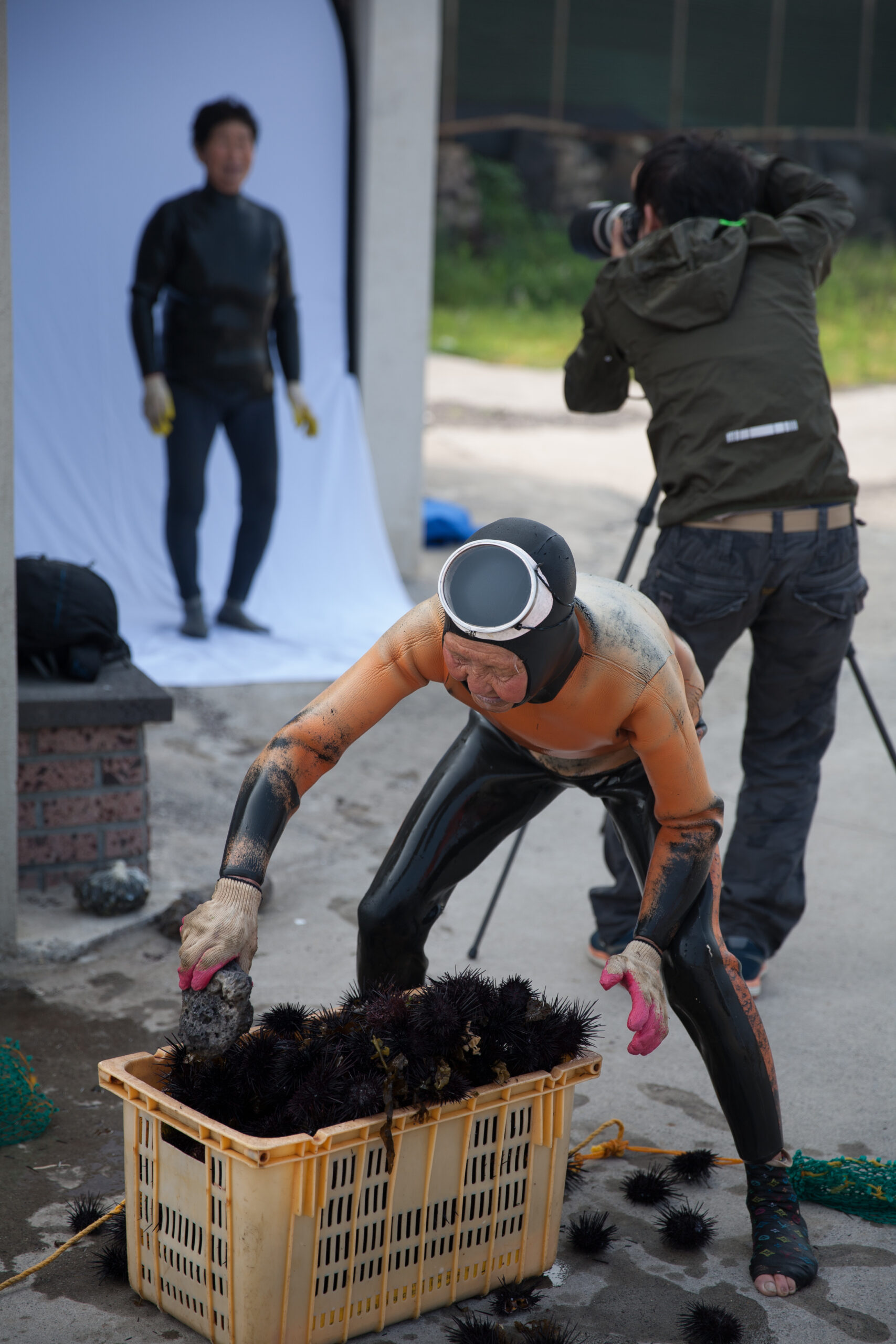
The haenyeo who just came out from the deep, heavy, and gloomy sea stand before the camera, waiting for a picture to be taken. They probably felt annoyed and inconvenienced. The artist stayed with them for a long time in order to persuade them to stand before the camera. Our eyes meet those of the old women divers wearing rubber diving suits and swimming goggles and carrying some tools. Their eyes staring into the camera lens seem to be looking directly at us. We can feel them concretely and realistically. As they just came out from the water after staying there for several hours, they are breathing hard and look completely exhausted. They are mostly aged women. Brightly shining in the photographs are their deep creases and age spots, short permed hair, cotton gloves, swimming goggles, and mesh vessels. Water cascades off their black diving suits and weights used to help sink their bodies are bound around their waists. They hold spears in their hands, flippers under their arms and lean on sticks. The details of their faces, diving suits, and other tools give out light, conveying a story. All the details captured in the artist’s photographs, such as the wrinkles on their faces, their expressions, the beads of water on their diving suits, and the texture of the tools they carry comment on what their identities, their lives, and labor must entail.
His photographs weave narratives with texture, tone, and color. Because photographs are frozen standstill images we can observe their details. These still photos enable us to gaze at, observe, and look into them for a long time. We can thus feel some emotion through the details. Kim’s haenyeo (women divers) photographs catch our eyes with the texture and color of their details. A good photograph has the power to hold a viewer’s gaze. Unlike the observation of our naked eyes, photographs give viewers details of visual images that we can closely and persistently observe. We interpret their lives and fates through these details. In this way, a photographic image is akin to a text.
The artist unfolds white cloth on the back of haenyeo with the intention of drawing attention to bodies and appearances. Creases give away that it is an artificial backdrop. The bodies are detached from the nature in which they exist and are excluded by it. This is an intentional device to exclude all places and episodes associated with their labor and make viewers pay attention to only their faces and bodies. This compels us to take note of only their faces, garments, and tools, hampering diverse associations, stories, and narratives. We can only imagine their lives and work through their faces. Faces always convey some very concrete narrative, so these faces become the object of our interpretation. In this case, we can think of the face as a text. One’s face is thus a book or a forest fraught with the scars of experience and life. This is why a face cannot deceive us. It is a history book that cannot be written with characters. The face is a text we have to read with great care. The lines and blemishes of a face are like sentences. However, these sentences are not easily deciphered as they are not structured in specific grammatical systems. The face is thus a sentence with no rules.
Kim collects haenyeo’s faces and bodies and observes, reads, and chronicles their details with great care. Natural and unartful, their faces are captured in vivid scenes. These are faces quite different from contemporary people’s artificial and adorned faces. The faces and bodies of Jejuhaehyeos have been formed through lives lived in harsh nature. Their faces and bodies are thus historic. Urbanites forgot and lost this historicity long ago. These photographs do not merely capture haenyeo’s faces as symbols but are evidence of the great lives of those who have lived their lives tenaciously, even in the harsh environments and natural settings of Korea. Not only Jeju haenyeo’s lives, but our grandmothers’ and mothers’ faces overlap in his works. These photographic works display true human faces formed in the process of living in harsh nature.